

An unprecedented ban on surface water usage in the Yakima Basin shut off irrigation early and disrupted city water services this month.
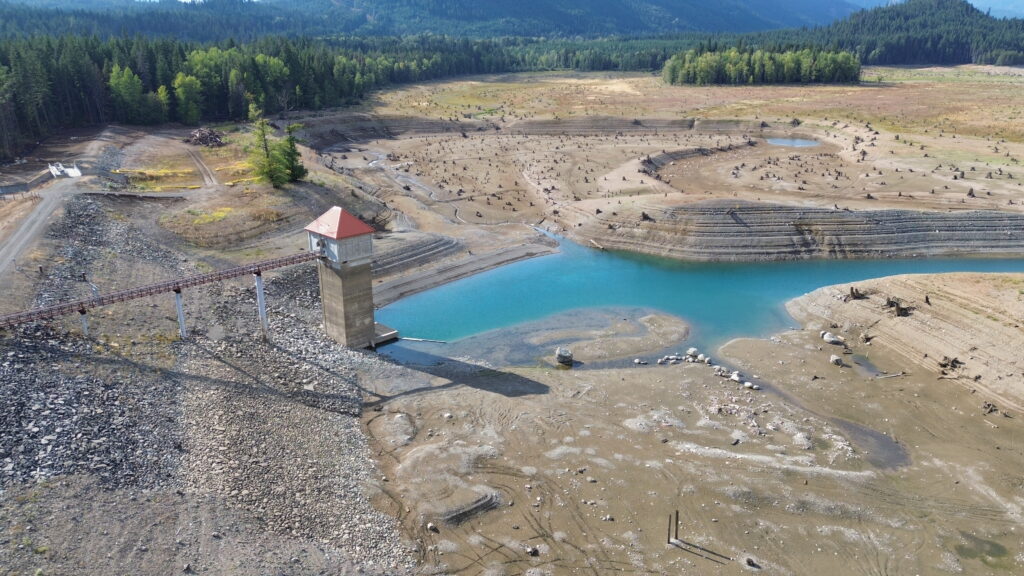
It was the first time the Washington State Department of Ecology has restricted river diversions for the entire river basin for all but the most senior water rights holders in the region.
The Wapato Irrigation Project on the Yakama Reservation holds multiple water rights, including an 1855 irrigation right which is outside the scope of the curtailment order, but Yakama Nation Department of Natural Resources Superintendent Phil Rigdon said the WIP and the Bureau of Indian Affairs reduced irrigation throughout the summer.
State regulators say the decision — which is in place through the end of October —was triggered by extended dry conditions and reservoir depletion.
“We saw historical conditions where the reservoirs in Yakima ran dry. We haven’t seen that before at this scale. The last time we saw this was about 30 years ago,” said Berns.
Yakima was the center of a landmark agreement between tribes and farmers that followed an extended period of water rights adjudication that spanned four decades.
Determining which water users take priority in an area with finite resources and competing claims is a contentious legal process.
That process is just getting underway in the Nooksack River watershed which covers most of Whatcom County and parts of northern Skagit County.. The Washington State Department of Ecology filed the Nooksack Adjudication in Whatcom County Superior Court in May of 2024.
The adjudication will formally list and rank all water rights within the boundaries of Water Resource Inventory Area 1. It is a legal process with binding conditions for all current and future water users in the watershed.
Some environmental groups are backing the decision to sort out Nooksack water rights in court.
According to Berns, the Nooksack Indian Tribe and the Lummi Nation petitioned the Washington State Department of Ecology to initiate the process.
The tribes issued a joint statement in support of adjudication in 2021 after lawmakers allocated funding for the process. In the statement, the tribes argue that settling water competing water claims is necessary to protect the survival of salmon, but efforts to find voluntary local solutions have seen little success.
A number of farmers in Whatcom County are worried about what the Nooksack litigation will mean for their livelihoods. There are reportedly existing farms without documented water rights. Others are worried about periods of inactivity which can carry consequences under the state’s ‘use it or lose it’ relinquishment framework.
“If you don’t utilize your full extent of your water right for five years they can take it back,”said Marty Maberry, Board Chairman at Maberry Packing.
“These water rights go back to the 40’s and there’s been a lot of changes and nobody even knew about relinquishment until the early 90’s. That’s a huge issue. We think it’s very unfair,” he continued.
Ecology established an in-stream flow rule for the Nooksack River in 1985. That set a legal standard for the minimum amount of water that must be flowing to preserve the health of salmon and other species.
Stream levels routinely drop below that threshold in the summer, which is also when crops need water the most. Some farmers in Whatcom County worry that means their water rights will be curtailed in the future.
“If you were just to go with an adjudication, you would require everybody to be cut off because in water law it’s the senior right who gets all their water first,” said Fred Likkel, head of the Whatcom Family Farmers organization.
“We want to make sure we’re respecting treaty rights in this whole thing, but that means we’re going to need to come to solutions, because I don’t think we’re going to be able to cut everybody off,” Likkel continued.
Whatcom County lacks the water storage infrastructure that exists in the dry Yakima basin.
“We don’t have reservoirs, so there’s no way of meeting these flows,” said Maberry.
Berns sees adjudication as a necessary starting point to find out who has water rights, who uses water, and how much water is actually available for use.
“Without having a sense of the scale of the problem we can’t work together in the community to identify infrastructure projects or other kinds of projects that will help lessen the gap between supply and demand,” said Berns.
Editor’s note: This story was updated to correct that the Yakama Nation was not subject to Ecology’s curtailment order and to add context about how the water shortage impacted irrigation on the reservation.