

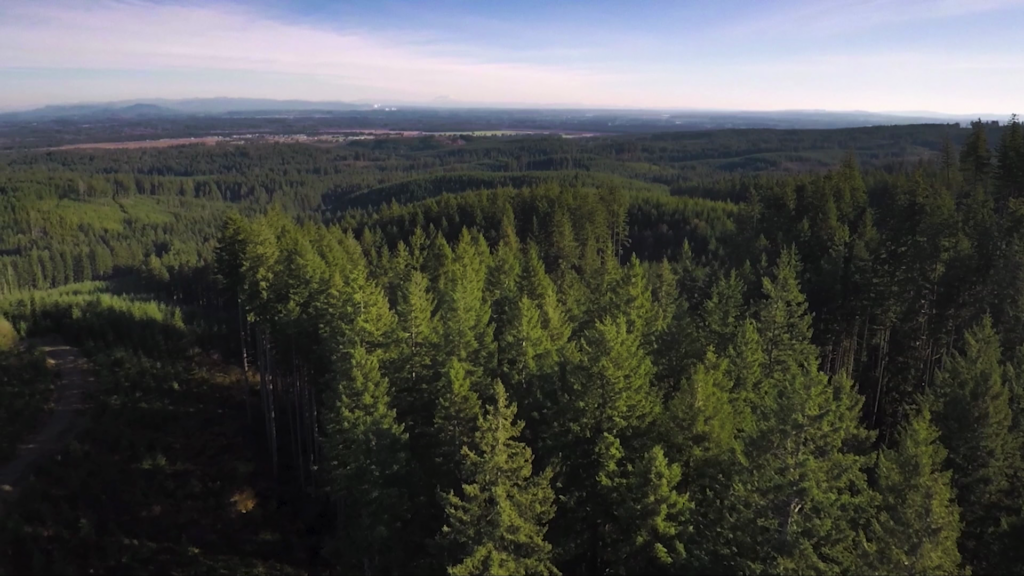
An aerial view of Capitol Forest near Olympia, WA. Courtesy: TVW
Conservation groups and the timber industry are split on the new direction for state forest management under Lands Commissioner Dave Upthegrove.
Last summer, Upthegrove announced that the Washington State Department of Natural Resources would conserve 77,000 acres of state-managed forest lands originally slated for harvest. According to the DNR, that figure includes 67,000 acres of structurally complex forest and 10,300 acres of older forest.
Those older stands of trees are often referred to as ‘legacy forests’ by conservation groups. That term generally refers to second growth trees that regenerated naturally and are at least 80 years old, but don’t meet the criteria for old growth protections.
The policy shift has been celebrated by various environmental organizations, tribes, and conservation advocates. Supporters argue the lands in question are more biodiverse than plantation forests and carry important carbon storage and environmental benefits.
The policy shift has also sparked backlash over the consequences for counties which rely on state timber sales to help pay for essential services and schools and rural economies that are closely tied to logging and milling lumber.
The American Forest Resource Council, an organization that represents the timber industry, opposed the status change.
AFRC director of government affairs Heath Heikkila told “The Impact” that the decision will have serious consequences for rural county economies in Washington.
“Many of these rural communities don’t have Microsoft. They don’t have Boeing. They have sustainable timber management to be able to employ people and generate and contribute to the tax base,” said Heikkila.
According to Heikkila, about half of DNR state trust lands in western Washington are already protected from harvest under habitat conservation plans and the new set asides represent a ”huge portion” of the remaining available timber.
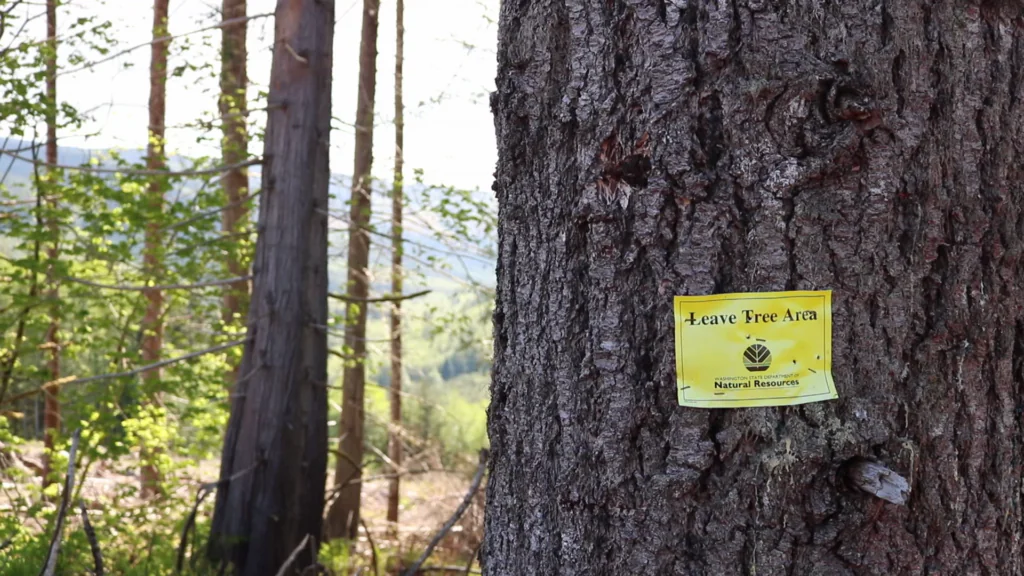
A yellow sign marks a tree as off-limits to harvest on DNR managed land. Courtesy: TVW
“Setting aside more DNR state trust lands under the guise of carbon will actually not benefit our climate at all and that is because we’ll simply substitute the products. So if we don’t produce these products here in Washington under our tight environmental and labor laws, we are going to import these products from elsewhere,” said Heikkila.
Miguel Pérez-Gibson, forest policy advisor for the environmental group Washington Conservation Action, estimated that state forestland produces between 400 and 500 million board feet a year. He argues that significant amounts of logging will continue on state managed lands with or without the 77,000 acres in question.
“If state forest land even produces 400 million board feet, that’s 80,000 log trucks. So there’s a lot of wood coming off of DNR’s land,” said Pérez-Gibson. ”How we treat this particular cohort of structurally complex forests is the question.”
He believes the state has reached a turning point for how the value of state forests is assessed and how the trees are managed moving forward.
“I mean, snowpack, water retention, flooding, cooler water for salmon. There’s a bunch of benefits to these forests that we have to look at,” said Pérez-Gibson.
Upthegrove has proposed thinning operations and selling carbon credits as alternative ways to earn money for trust beneficiaries from the acres under conservation. A bill to allow the DNR to sell carbon credits failed in the 2026 legislative session.