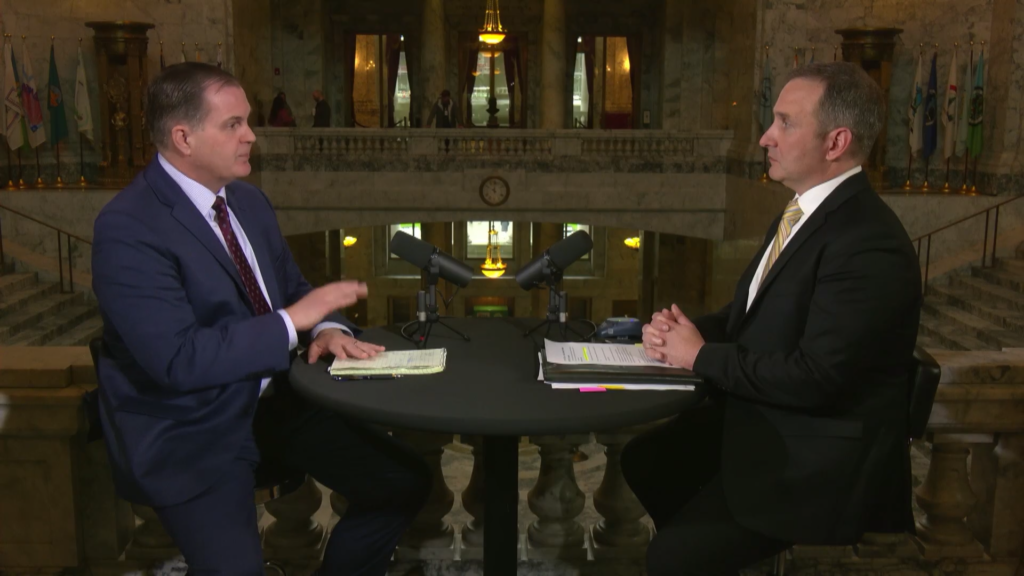

Governor Bob Ferguson answers questions from MIke McClanahan, host of “The Impact”, during TVW’s special coverage of the start of the 2026 Legislative Session, Jan. 12, 2026.
Lawmakers returned to Olympia this week facing another sizable budget deficit, a major tax proposal, and a new round of difficult spending decisions.
Gov. Bob Ferguson’s proposed budget includes more cuts, and big transportation investments, but the piece drawing the most attention is a proposed income tax on millionaires.
The governor’s plan would impose a 9.9% tax on annual net income above $1 million. Ferguson says the tax is not based on net worth so the value of a home won’t count towards that threshold. The governor is also asking for corresponding tax reductions in other areas.
If passed, Ferguson says the tax will have no effect on the current budget shortfall because revenue would not arrive until 2029 and only it survives an expected legal challenge.
The governor elaborated on his proposal in an interview during TVW’s opening day coverage of the legislative session.
“Folks who are very wealthy pay a very small percentage of their income in taxes, about 4%. Almost all other Washingtonians pay about 13% of their total income in taxes. That’s regressive. That’s not fair,” said Ferguson.
Washington is one of nine states without a state income tax. A 1933 Washington Supreme Court decision held a graduated income tax unconstitutional.
Since then, state voters have rejected income tax proposals several times in a row. Opponents of a state income tax argue the people of Washington have spoken clearly, again and again, against an income tax.
Some proponents of progressive tax reform point to the 2024 defeat of an initiative to repeal the state capital gains tax as a sign that voter sentiment has shifted and the electorate is ready for a state income tax.

“You know, we’re going to find out, but I think the answer is yes,” said Senate Democratic Majority Leader Jamie Pedersen.
The push comes two years after a bipartisan majority of lawmakers passed I-2111, an initiative to bar state or local governments from imposing or collecting income taxes.
The governor says he will not sign an income tax that targets non-millionaires and would support a constitutional amendment to bar any expansion of the tax to middle-class families.
Such an amendment would require approval from state voters, but first it would require a two-thirds vote in both legislative chambers. That many votes would require bipartisan support and Republicans were quick to condemn the proposal.
“I don’t think there’s any path to getting bipartisan support for the proposal. So, I don’t think that there’s really a path to a constitutional amendment,” said Pedersen.
Senate Republican Leader John Braun argues it’s the wrong time for any kind of tax increase citing tax increases signed into law after last year’s legislative session.
“If you’re serious about actually improving the level of our progressivity in our tax system, reducing regressive taxes, you’ve got to actually not just put that in place, but also take away taxes. I don’t think there’s been any preparation to do that,” added Braun.