

It’s been almost 25 years since the last significant earthquake in Washington and more than 300 years since the tremendous fault offshore roared to life.
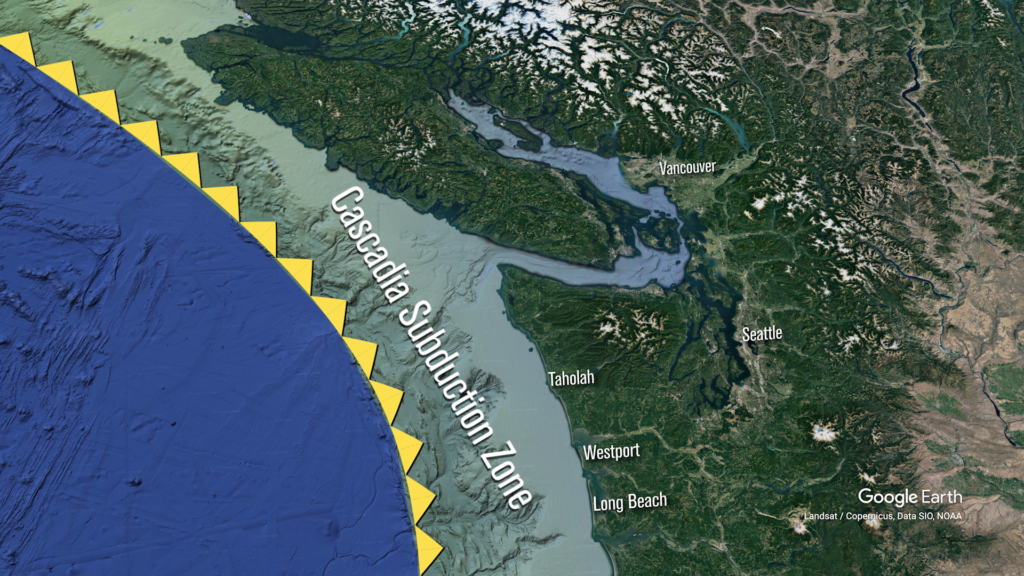
A deep intraslab fault generated the magnitude 6.8 Nisqually earthquake that damaged brick buildings from Olympia to Seattle in 2001. The Cascadia Subduction Zone (CSZ) fault that runs along the seafloor off Washington’s coast will do a lot more than that the next time it ruptures completely.
“It would be about five minutes of the most violent shaking you can imagine. Windows are rattling, doors are banging, glass is breaking. All sorts of stuff is falling down,” Alex Steely, Assistant Director for Geologic Hazards and Mapping at the Department of Natural Resources, said in an Impact interview on TVW.

The fault stretches from Northern California to Vancouver Island. In addition to the shaking, emergency planners expect it to send a large tsunami into coastal areas.
A recently published Oregon State University study suggests there could be a link between previous CSZ quakes and earthquakes along the San Andreas fault in California.
The notion that the two faults might be capable of triggering each other raises troubling questions.
According to Steely, it’s a frightening scenario, but a speculative concern for now.
“There’s a lot of evidence across the world that large earthquakes can trigger other earthquakes on different faults,” said Steely.
“There is some emerging evidence that suggests that there have been times when both faults ruptured, sort of in the same time frame, but our dating of those events is not entirely certain yet,” he continued.
A U.S. Geological Survey study published in September examines the respective probabilities of the different types of earthquakes that can occur in the Pacific Northwest. There are deep faults, such as the one responsible for the 2001 Nisqually earthquake, shallow crustal faults, like the Seattle Fault, and megathrust faults, like the Cascadia Subduction Zone.
The study lists an estimated 85% chance of another deep earthquake of magnitude 6.5 or larger, a 17% chance of a similar-magnitude crustal fault earthquake, and a 10-15% chance of a magnitude 9 megathrust CSZ earthquake over the next 50 years in the Puget Sound region.
Find the full interview here: https://tvw.org/video/the-impact-dual-disasters-study-links-major-wa-and-ca-earthquakes-2025101158/