

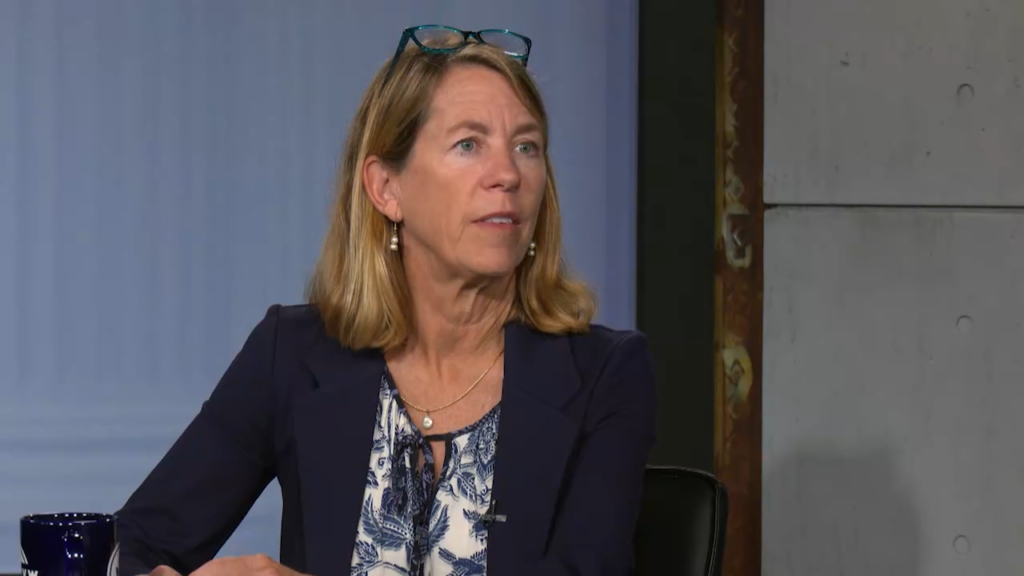
Marguerite Roza of Georgetown University’s Economics Lab in Seattle on the set of The Impact with Mike McClanahan. (TVW)
OLYMPIA, Wash. — State assessment scores in key subjects like math and reading have repeatedly missed benchmarks in recent years, even as Washington has significantly boosted its investment in public schools.
“We have a lot more money in our schools today than we did a decade ago and what we’re not seeing is any sort of corresponding bump in the key student outcome measures,” said Marguerite Roza.
(Contributed Image below)
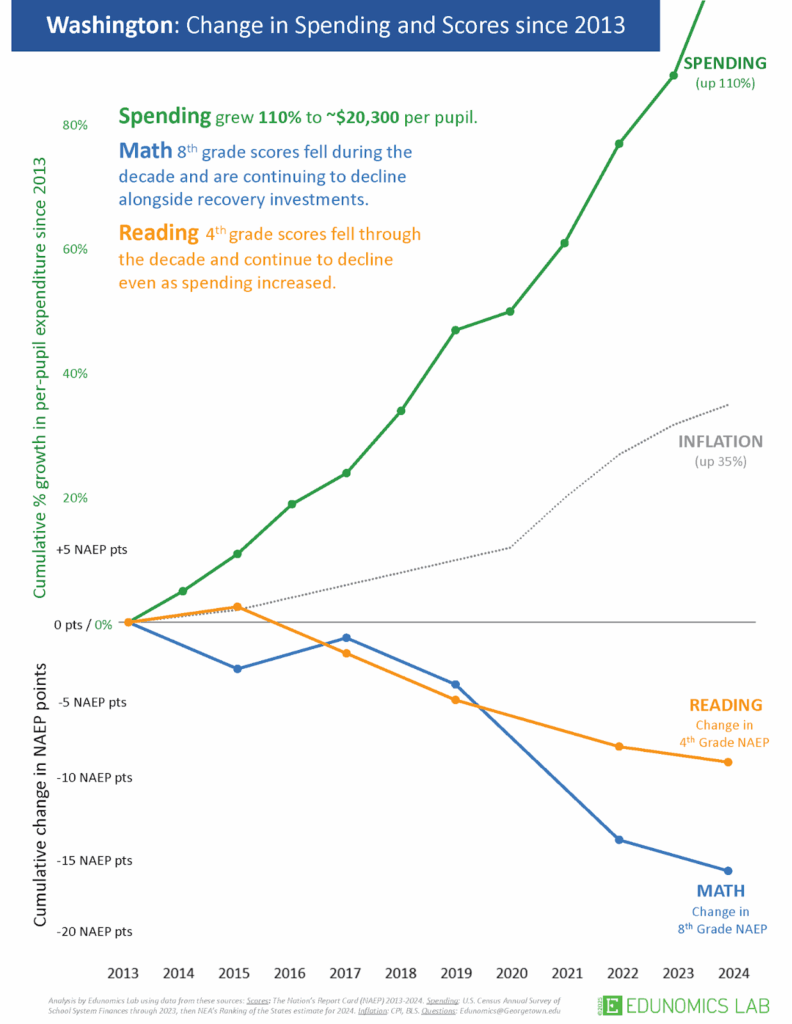
Source: Edunomics Lab, Georgetown University, Washington Change in Spending and Scores Since 2013 (2025)
Roza is a research professor and director of Georgetown University’s Economics Lab in Seattle where she leads the education finance certification program. Her work involves analyzing how education dollars are spent in different places and tracking the outcomes for students. Two benchmarks for Roza are the National Assessment of Education Progress (NAEP) scores in fourth grade reading and eight grade math.
”If you don’t learn to read, you can’t get the value out of the rest of your years in education and eighth grade math, it turns out, is a really important predictor of a whole host of things that we care about, including the state’s future economy and students’ lifetime earnings,” said Roza, during a recent interview on TVW’s The Impact.
Washington’s NAEP scores have trended higher than the national average, although the gap has become increasingly narrow in recent years. Roza says more money in a school system is generally associated with improved outcomes, but how the money is used makes a big difference.
“I think one of the things Washington has been a leader on is putting some money into students that are experiencing homelessness, homelessness, and that small amount of dollars really drove some big improvements for students that are homeless. That money was cut in the last session,” said Roza. “Don’t downplay the test scores. Don’t say, oh, well, we have something else— that doesn’t matter. That’s just not being honest or fair with kids. We need to go figure out what’s going on here. And we need to commit to seeing that improvement.”
The head of the state’s largest union for educators, the Washington Education Association, argues that assessment results are not a good way to gauge public school performance. WEA President Larry Delaney is a high school math teacher in Snohomish County.
“To take an assessment which is a single marker in time. It’s a day that a student showed up. We don’t know whether that student had a safe place to sleep the night before, had a meal that day, what the mental and behavioral health challenges of that student are. To take that as a marker of success, or something less than successful public schools is certainly, it’s not a reliable measure,” said Delaney on The Impact.
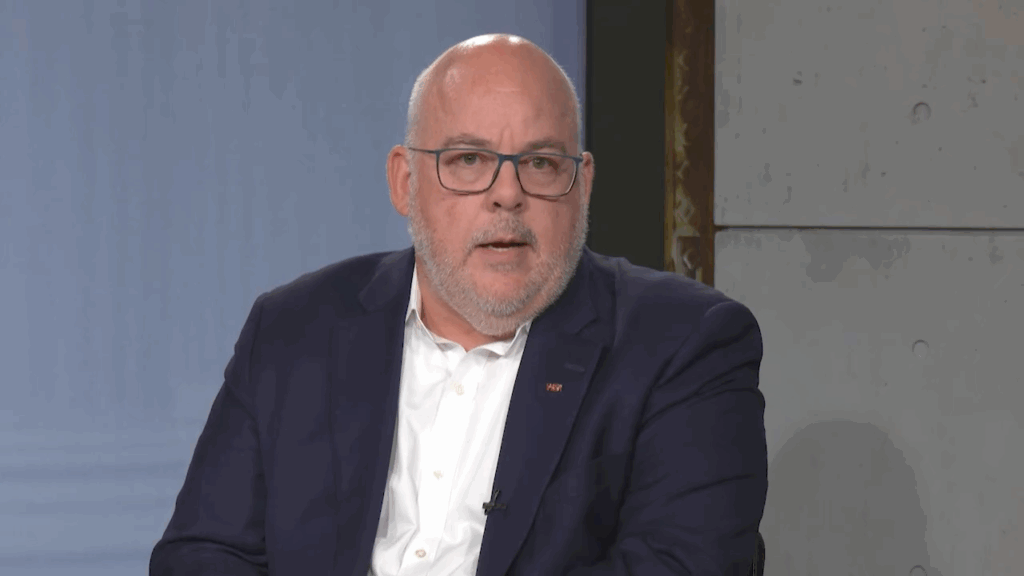
WEA President Larry Delaney on The Impact (TVW)
“There’s amazing work that’s being done by educators, across the state, on a daily basis,” said Delaney. “There’s a myriad of gaps coming out of the pandemic. We know that there are gaps. I would like to see the focus on how we close those gaps, rather than a number on a piece of paper.”
“We’ve got more and more students who are coming with unmet needs from outside that falls on the shoulders of the public schools to bridge gaps. Whether that’s food, whether that’s your mental and behavioral health, there’s just so much that our students need that our system is not prepared to deliver,” said Delaney.
He is encouraged by the legislature’s move to raise the cap on local property taxes devoted to schools, but he is concerned that it could further inequities in the system.
“It’s certainly a step in the right direction when it comes to school funding. One of the challenges was the levy cap. I think we’ll have to wait and see what it means. We’ve seen that over the last several years, it’s been more and more difficult for districts to pass levies,” said Delaney. “It’s also not a substitution for some of the greater funding challenges that still exist in public education.”
He hinted at what the WEA will be pushing for when state lawmakers reconvene in 2026.
“We need to have some meaningful new revenue streams coming out of Olympia. I think the reality is that we don’t have the resources to fund public education as it needs to be funded in 2025,” said Delaney.
Roza’s advice to policy makers is not to ignore the trends in reading and math scores.
“When the state lawmakers put more money in the system, I think it’s fair to say, yes, we should put more money in the system, and yes, we should expect more for the students on the other side. To put more in the system and then see these scores fall, I think is concerning. I don’t think it’s fair to this next generation of students,” said Roza.
On September 10th, OSPI Chris Reykdal, announced the results of state tests, which utilize the Smarter Balanced Assessment System. Reykdal framed the test scores as positive in multiple areas, such as an accelerating rate of improvement and Washington’s high ranking among the 11 states which take that test. He noted that the tests also highlight persistent gaps which need to be addressed. Reykdal takes issue with how the 1-4 scoring system has been interpreted.
Smarter Balanced Assessment Scoring
- A score of one means below grade level knowledge.
- A score of two according to OSPI, indicates foundational grade level knowledge. In other descriptions of Smarter Balanced Assessment scoring, a score of two has been described as “standard nearly met.”
- A score of three represents consistent grade-level knowledge.
- A score of four indicates a student has advanced knowledge for that grade-level.
The majority of Washington K-12 students as a whole scored at least a two, but there are dramatic score disparities between various student groups.